2000–2009
LA FÊTE DU PROGRÈS
Conception, creation and artistic direction: Carl De Moncharline
When politics goes behind the bar
In the early 2000s, the political world still maintained a relationship with nightlife that was, to say the least, ambiguous. For some, clubs and parties were primarily synonymous with nuisances, excesses, and security problems. Yet, behind these places of conviviality lay an entire professional sector, with its entrepreneurs, artists, teams, and economic realities.
I wanted to change this outlook. And for that, rather than multiplying speeches, why not invite political leaders to spend time on the other side of the counter? Put them behind the bars, let them participate in the party, and allow them to concretely discover our professions.
My ambition went further: to bring together organizers, clubs, and actors of Brussels' festive life around the same event. A sort of mini-Fête de l'Huma, in our own way, where politics would meet popular culture in a resolutely festive atmosphere.
I presented this idea to Elio Di Rupo, who immediately welcomed it with enthusiasm. Philippe Moureaux, though of a more austere temperament, was just as enthusiastic and gave his green light for the involvement of the Brussels Federation of the Socialist Party in this festive adventure. It just goes to show that even the most serious people can let themselves be dragged onto the dance floor!
With Olivia P’tito, who would become one of the key pillars of this adventure by my side, we brought to life this project that I had imagined from scratch.
This is how La Fête du Progrès was born, organized for the Socialist Party.
Another idea of the party
At the time, my activities in clubs had mostly led me to evolve in the worlds of house, techno, hip-hop, and R&B. For La Fête du Progrès, I deliberately chose to take the opposite direction of these programs.
Jazz, French chanson, rock, pop, world music, brass bands, cabaret, electro, folk, Balkan music... Each edition was an opportunity to explore new artistic territories and to have different audiences, generations, and sensibilities live together.
From the first editions with Jean Demannez, Sans Set Quater, or Crema e Gusto to the programs hosting, among others, Emma Peel, La Varda, Sioen, Miele, Monte Video, Les Hurlements d’Léo, or even Balkan Beats, La Fête du Progrès gradually asserted a singular, deliberately eclectic musical identity.
The Botanique, with its multiple rooms and outdoor spaces, offered an ideal playground for this meeting of genres. Concerts, themed evenings, performances, family activities, and gourmet villages followed one another, while organizers from different backgrounds of the Brussels night took possession of the spaces.
From the evening to the festival
As the editions went by, La Fête du Progrès grew, both in its ambitions and in its programming and deployment. The initial idea had become a real cultural and festive meeting, bringing together political leaders, artists, event professionals, and audiences from all horizons.
In 2007, the event crossed a new threshold with an outdoor festival formula, at Tour & Taxis, under tents, mixing concerts, DJ sets, animations, and very different musical universes.
This evolution represented, in my eyes, the natural culmination of the project. La Fête du Progrès had now acquired a dimension that far exceeded that of a simple political evening.
When competition joins the dance
The success of La Fête du Progrès clearly did not go unnoticed by other political groups. By bringing political leaders into the universe of the party and attracting an audience that did not necessarily attend traditional party events, we had opened a path that few people believed in at the start.
In 2006, I thus discovered with a certain amusement "Les Fêtes de la Liberté," organized under the colors of the MR. Three evenings in Charleroi, Liège, and Brussels, including one at the Mirano Continental, accompanied by a communication that did not fail to remind me of something.
First, the name: Les Fêtes de la Liberté, a fairly transparent variation of our La Fête du Progrès. But above all, the visual: a turntable, precisely that object we had chosen to embody the graphic identity of our event since its first editions.
Coincidence? I will let everyone judge for themselves. But I must admit that finding this flyer in my archives made me smile. The MR had even called upon a few well-known figures of the night, including Stéphane Pompougnac, Charles Schillings, and Craig Walker.
The environmentalists were also going to explore this meeting between politics and festive culture with Vert Pop.
What amuses me still today, looking at these posters, is to note that the MR had also adopted a turntable as the symbol of its evenings. A resemblance that is savory to say the least with the graphic universe I had developed for La Fête du Progrès.
The environmentalists, for their part, had chosen another identity for their Vert Pop evenings, but were part of this same desire to bring politics, music, and celebration together.
As for the quality of the visuals, I will let the archives speak for themselves. After all, having the idea to organize a party is one thing. Giving it a real artistic identity is another.
Deep down, what pleased me most was not so much seeing other political parties appear, but seeing how much an idea, welcomed from the start with enthusiasm, but whose potential no one could yet measure, had ended up inspiring other initiatives.
Knowing how to grow… or knowing when to leave
After the 2007 edition, the Socialist Party wanted to return to a more modest formula, notably by reintegrating the Botanique. An orientation that I understood from the point of view of organizational constraints, but which I did not share.
In the event industry, growth dynamics are essential. An event that grows creates expectations, an identity, and a collective energy. Returning to a smaller scale, even for perfectly legitimate reasons, risks being perceived by the public as a step backward.
I therefore considered that after having given La Fête du Progrès a festival dimension, it would have been difficult to go back without weakening what we had built.
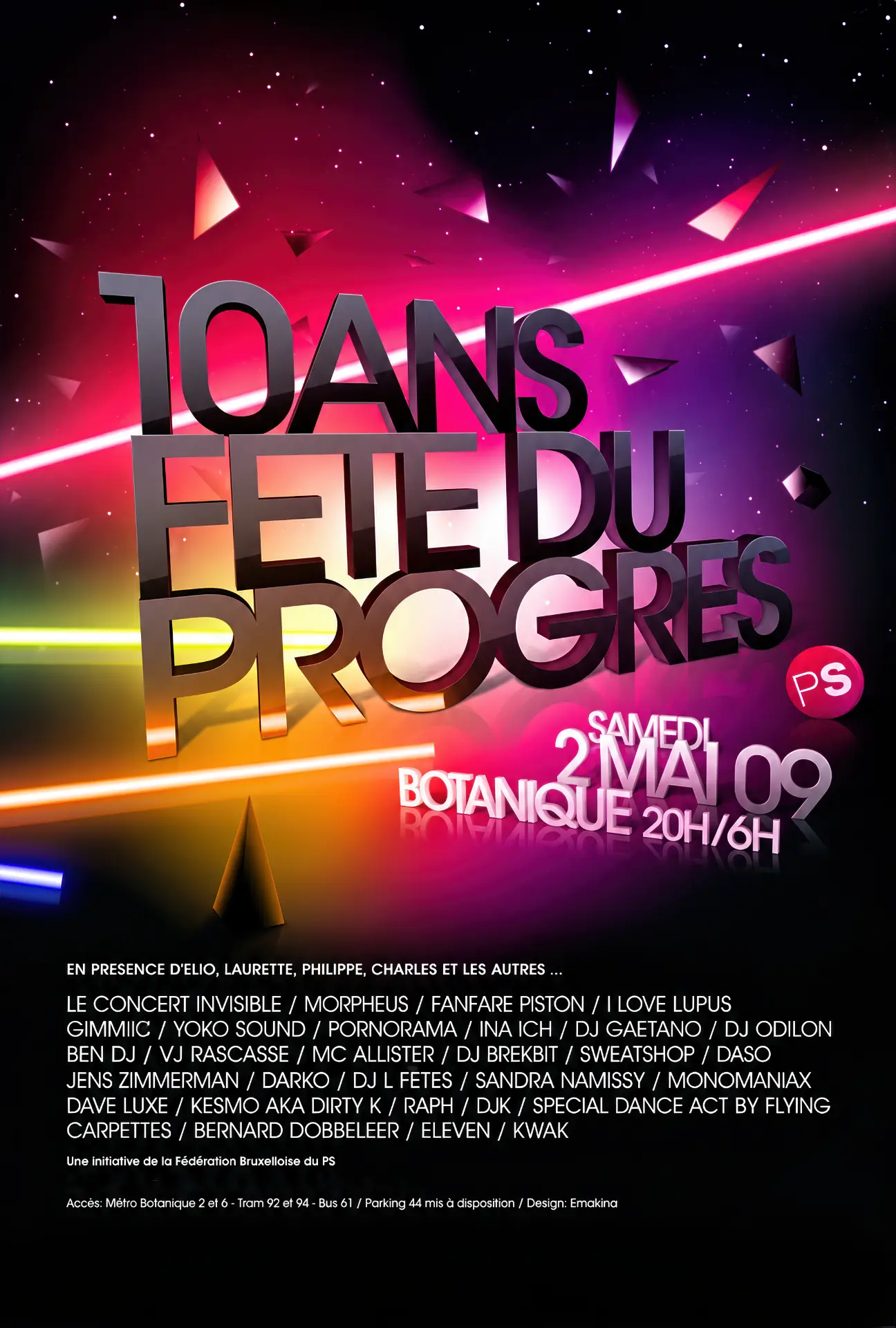
I nevertheless insisted on continuing the adventure until 2009, the year of the tenth anniversary of La Fête du Progrès. This date had a symbolic value for me. Ten editions was also the opportunity to measure the distance traveled since that first somewhat bold idea.
But faced with the desire to return to a more modest formula, I preferred to end my collaboration after this anniversary rather than accompany an evolution in which I no longer believed.
La Fête du Progrès thus saw ten editions, from 2000 to 2009. I keep from this decade the memory of an exceptional human and artistic adventure, built with Olivia P’tito, the teams of the Socialist Party, and the many organizers, artists, and partners who agreed to follow me.
From a somewhat bold idea to a real festival, La Fête du Progrès will have been the opportunity to create a dialogue between two worlds that had much to learn from each other: the world of politics and the world of the party.
Communication visuals
View all →